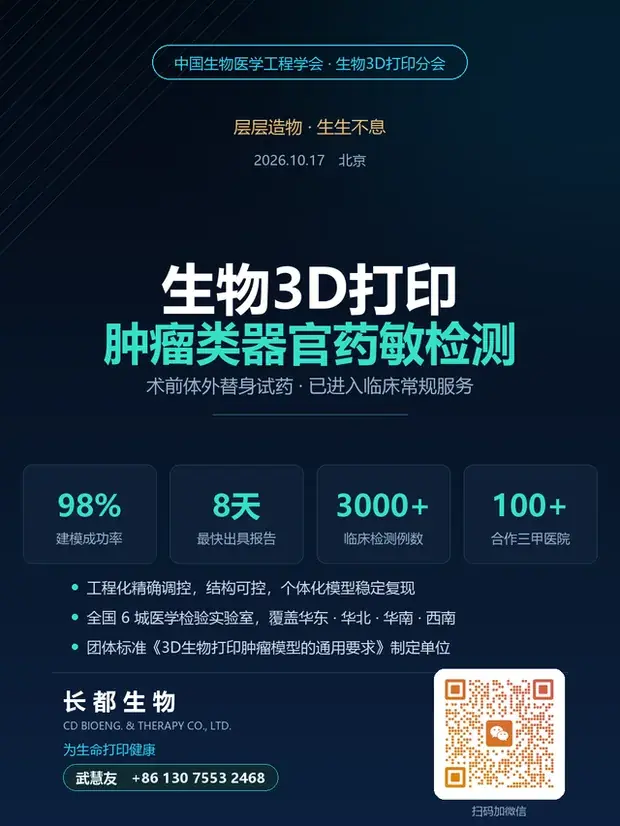
Printing Health for Life: Bioprinted Tumor Organoid Drug Sensitivity Testing
Using a patient's own tumor cells to print three-dimensional organoid models, testing drugs outside the patient's body on their behalf. Engineered precision control with controllable structure turns "preoperative in vitro stand-in drug testing" from research papers into a routine clinical service.
Core Metrics
Four Sets of Numbers Already Proven
Modeling success rate
98% (engineered precision control, stable model culture)
Report delivery
As fast as 8 days
Clinical test cases
Over 3,000 individualized drug sensitivity tests completed, covering multiple tertiary hospitals nationwide
A designed and planted garden — engineered precision control, controllable structure; the traditional approach is closer to "natural growth," with consistency left to chance
Modeling success rate
Bioprinting approach about 98%, stable and reproducible model culture
Turnaround
After process standardization, reports in as fast as 8 days, keeping pace with clinical decision-making
Structural controllability
Printing paths, cell distribution, and matrix structure are program-controlled, with minimal batch-to-batch variation
Application scenarios
Preoperative medication plan reference, parallel in vitro comparison of multiple plans, drug resistance and sensitivity assessment
Laboratories
National Medical Laboratory Layout
City
Location
Scale
Status
Beijing
Dongcheng District core urban area
Approx. 1,200 sqm
Completed
Shanghai
Fenglin Life Health Industrial Park, Xuhui District (adjacent to Fudan Cancer Center and Zhongshan Hospital)
Approx. 1,300 sqm
Completed
Ningbo
Xiaogang, Beilun District (Phase II located in Haier Shi's industrial park under construction)
Phase I nearly 1,000 sqm, Phase II approx. 2,000 sqm
Completed
Chengdu
West China Health Valley (industrial park in deep cooperation with West China Hospital)
Approx. 1,200 sqm
Under construction
Zhengzhou
Central urban commercial area, adjacent to the First Affiliated Hospital of Zhengzhou University, Henan Provincial People's Hospital, and Henan Cancer Hospital
Approx. 1,500 sqm
Under construction
Guangzhou
Liuhua Center (former Canton Fair site, reaching ASEAN countries)
Approx. 2,500 sqm
Site selection in progress
Team
Who Is Behind This
Company background
Jointly founded by a professor team from Peking Union Medical College Hospital, a professor team from Tsinghua University, and Haier Shi Biopharmaceutical Co., Ltd.
Team size
100+ people, including 12 PhDs
Academic output
44 authoritative papers, including Gut, Molecular Cancer, Science Advances, Advanced Science, Biomaterials, etc.
Intellectual property
20+ applications
Academic society positions
The Biomedical 3D Printing Branch of the Chinese Society of Biomedical Engineering was established; Professor Sun Wei of Tsinghua University serves as the first chairman; Yu Jianwei, Chairman of Haier Shi Group, serves as vice chairman; Xie Zhibo, Medical Director of Changdu Bio, was elected as a committee member
Scientific advisors
Yang Huayu (Researcher, Department of Liver Surgery, Peking Union Medical College Hospital), Mao Yilei (Professor of Liver Surgery, PUMCH; Founding Editor-in-Chief of HBSN), Pang Yuan (Associate Researcher, Tsinghua University), Sun Wei (Professor, Tsinghua University; Founder of SunP Biotech)
Qualifications
Standards and Projects
2026 Smart Healthcare Insurance Competition
First prize, ranked 1st among 240 finalists — recognised by China's National Healthcare Security Administration
Group standard
Led the formulation of "General Requirements for 3D Bioprinted Tumor Models" — the first group standard in this field domestically and internationally
Quality control
Established SOP for drug sensitivity testing workflow; published "Quality Control Standards for 3D Bioprinted Tumor Model Diagnosis and Treatment Platform"
National-level project
Approved for the 2024 National Key R&D Program project: Additive Manufacturing of Fine Multicellular Microenvironment Organ Chips and Clinical Drug Screening
Development history
2016 initiated bioprinting exploration → 2018–2020 expanded to clinical trials for individualized medication guidance in liver cancer, cholangiocarcinoma, colorectal cancer, pancreatic cancer, ovarian cancer, glioma, and other cancer types → platform continues to expand to date
CD BIOENG. — commemorating the founding of the Bio-3D Printing Branch, Chinese Society of Biomedical Engineering
FAQ
Four Questions Most Asked by Clinical and Research Partners
What clinical problem does this test solve?
Before a patient officially starts medication, their own tumor cells are used to construct organoid models in vitro and test multiple drug regimens, providing reference for clinical selection — what is called "preoperative in vitro stand-in drug testing."
What sample is needed? How long for results?
Typically tumor tissue obtained from surgery or biopsy. After process standardization, reports can be issued in as fast as 8 days; actual turnaround depends on sample conditions and test items. Please confirm with the laboratory before sending samples.
How is this different from traditional organoid methods?
The traditional approach is closer to natural growth with greater batch variation; bioprinting program-controls printing paths, cell distribution, and matrix structure, achieving controllable and reproducible structures with a modeling success rate of about 98%.
Can we collaborate on research projects?
Yes. The company has long-term joint research with teams from PUMCH, Tsinghua, and other institutions, and also undertakes model construction and drug screening collaborations with hospitals and pharmaceutical companies. Please contact us directly for specific directions and scheduling.
For clinical collaboration, sample submission, and research projects, contact us directly
Wu Huiyou +86 130 7553 2468 (WeChat same number, scan code to add)
Same number on WeChat. Call directly, or scan the code to add us.
Scan to add on WeChat
We use cookies to measure traffic and improve our Google Ads performance. You can accept all cookies or keep only the essential ones. See our privacy policy for details.